The Bharat–Bali Connection: A Sacred Geography and the Birth of School of Cultivation
Twelve centuries ago a sage from Bharat was magnetically pulled to a river confluence in Bali. In 2013, I followed the same current. This is the lineage beneath School of Cultivation.
Some places are not discovered. They are remembered.
When I moved to Bali in 2013, I did not come with a curriculum in my pocket or a school in mind. I came the way seekers have always come — drawn by something I could not fully name, pulled across oceans by a gravity that precedes logic. I settled in Campuhan, in a small enclave at the confluence of two rivers. I did not know then what I was about to learn: that this exact piece of earth had been chosen, more than twelve centuries before my arrival, by a sage who made the same journey I had — from the Indian subcontinent toward an island that pulsed with something extraordinary.
His name was Rsi Markandeya.
And what happened at that river confluence — what he planted there, what he built there, what he laid as the invisible foundation beneath the place I would call home — is inseparable from what eventually became the School of Cultivation.
This is not coincidence dressed as story. This is the field, speaking.
The sage from Bharat
To understand Campuhan, you must first understand the man who found it. In the 8th century, a holy man named Rsi Markandeya set out on a spiritual journey across the island of Java, spreading the teachings of Hinduism. His title, Rsi — a seer, a sage, one who perceives beyond the visible — tells you what kind of man he was. Not a conqueror. Not a merchant. A man whose instrument was attention, whose mission was transmission.
Rsi Markandeya was a yogi and priest who practiced the Hindu Siwa Tatwa tradition from South India. In the early 8th century, he began his journey to the archipelago, his first destination being the Dieng Mountains in Central Java. He was a man who moved continent to continent, mountain to mountain, guided not by map but by revelation.
Bharat — the ancient name for the Indian subcontinent — and Bali. Two lands separated by oceans, united by something older than geography: a shared architecture of consciousness, a common understanding that the world is not matter arranged randomly but field arranged with intention. Rsi Markandeya understood this. And so he moved.
The failed first attempt
What makes his story so human — and so instructive — is that he did not arrive in triumph. He and his large group of followers reached Bali and attempted to settle near Taro, north of Ubud. They were struck down by a cholera epidemic and many perished. Rsi Markandeya led the survivors back to Java, where he returned to meditation.
He did not interpret the failure as rejection. He interpreted it as information. From the results of his meditation, it was revealed that the reason so many of his followers died was that he had not carried out the planting of Panca Datu — five sacred metals. The failure had a cause, and the cause had a remedy, and the remedy required ceremony.
You do not simply arrive at a place, physical or spiritual, and begin. You prepare the ground first. You make the offering. You ask permission from the field.
Panca Datu: five metals, five elements, one foundation
Before returning to Bali, Rsi Markandeya performed a grand ceremony of offering. At the site that would become Besakih — the Mother Temple of Bali, still standing on the slopes of Mount Agung — he planted Panca Datu: gold, silver, copper, bronze and iron. He added Mirah Adi, a gemstone symbolising ultimate power.
Five metals. Five elements. Five directions of reality. He was not building a temple. He was anchoring a field — establishing the energetic, elemental, cosmological conditions within which human life and spiritual development could actually take root.
This became the basis for the Balinese tradition of performing a yadnya ceremony before starting anything new — clearing land, building a house, establishing a temple. The ceremony before the work. The consecration before the creation. The invisible infrastructure installed before the visible one.
I did not know about Panca Datu when I arrived in Bali in 2013. But I understand now that something like it lives in the foundation of every genuine school. You consecrate the ground before you build on it. Even when you don't know you're doing it.
The magnetic pull of Campuhan
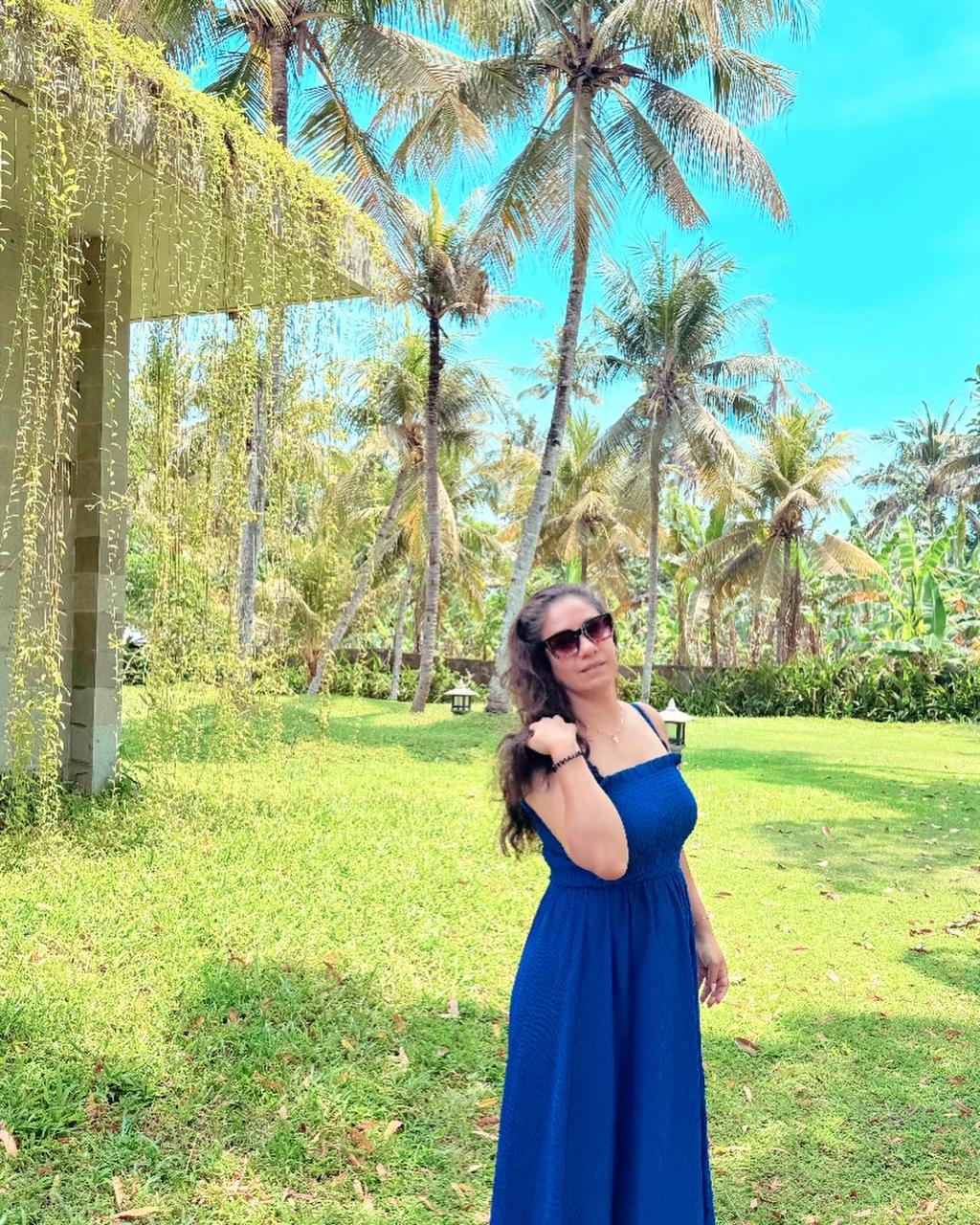
With Besakih consecrated and his followers safe, Rsi Markandeya continued through the island. And then something happened that cannot be entirely explained by reason. He was magnetically attracted to a destination in the central foothills that radiated light and energy. This place was Campuhan, at a confluence in the Wos River.
Magnetically attracted.
The language is precise and unusual. Not "he travelled to." Not "he decided on." Attracted — pulled, as iron is pulled toward a lodestone, as a consciousness tuned to certain frequencies cannot help but move toward what is calling it.
Here, where two branches of the Wos River — named Lanang and Wadon, male and female — meet in a confluence, he settled, meditated and built the temple Pura Gunung Lebah. These two rivers swirl around each other as two naga, dragons or serpents, might do.
Think about what he found there. A masculine current and a feminine current, flowing in parallel, carving their paths through ancient volcanic earth, and then meeting — not crashing, not one overwhelming the other, but converging. Becoming one body of water that is neither river alone, but something new. Something that carries the intelligence of both.
The name Campuhan symbolically means "the place where two rivers meet." One of those rivers, the Oos, takes its name from the Balinese word Usadha, meaning medicine.
Usadha. Medicine.
From Usadha comes Ubad. From Ubadcomes Ubud. The city itself is named for medicine, because the river that runs through it is medicine, because the sage who named it understood that water which has passed through charged ground carries the intelligence of that ground.
What he built there
Pura Gunung Lebah was founded in the 8th century by Rsi Markandeya as a sanctuary for meditation and spiritual retreat. Nestled where the rivers merge to form the sacred Campuhan, the site hums with serene energy, surrounded by forests rich with medicinal plants believed to heal both body and soul.
In Balinese, Campuhan signifies a liminal space where energies merge, amplifying both blessings and dangers. The temple has long been revered as a place of powerful healing, its soil and stones vibrating with energy that draws pilgrims, shamans and seekers of the unseen.
On subsequent expeditions, Rsi Markandeya built a number of other significant temples and created the shared irrigation system for the terraced landscape that is still practised by farmers today. The formation of the banjar — the village council responsible for community and religious affairs — was also inspired by him. Rsi Markandeya is, in essence, responsible for the foundation of Balinese Hinduism in its purest form, referred to as Agama Tirtha, the religion of holy water.
Agama Tirtha. The religion of holy water.
Not the religion of doctrine alone. A spirituality of living substance — water that moves, that nourishes, that purifies, that connects the high ground to the low ground, the mountain to the sea. And he did not keep it to himself. He built community structure, governance, terraces, ceremony. He understood that a living teaching requires living infrastructure. This is a man who understood what a school actually is.
Thirteen centuries later: a woman arrives at the same confluence
I did not know any of this when I moved to Campuhan in 2013. I knew I was tired. I knew something that had been driving me before — the ambition without roots, the speed without stillness — had run its course. I knew I needed to stop somewhere that could hold me, and then teach me.
I let that need lead me until I found myself at a river confluence in the central hills of Bali, surrounded by the sound of water moving over stone. I sat where a sage had sat twelve centuries before. I did not plant five metals in the ground. But I stopped. I became still. I listened.
Slowly, over years of living at that confluence — walking its ridges at dawn, sitting beside it in the evenings, practising my Qi cultivation in the mist that rose from where the two rivers met — something began to take shape in me. Not a curriculum. Not a business. Something more like a conviction.
That intelligence is cultivatable.
That the field — the Akashic field, the Qi field, the field of consciousness that Rsi Markandeya crossed continents to tend — is not something you receive passively. It is something you develop a living relationship with. Something you practise entering. Something you build capacity for, the way a musician builds capacity for sound, the way a farmer builds capacity for yield.
That there is a difference between visiting the sacred and becoming someone who lives from it. Campuhan taught me this — not by telling me, but by being.
The thread from Bharat to Bali to you
What Rsi Markandeya brought from India to Bali in the 8th century was not a set of beliefs. It was a set of practices. Ways of entering the field. Ways of reading the land and the body and the invisible architecture beneath both. Ways of building community that could hold something sacred across generations.
What I built at School of Cultivation is my inheritance of that tradition — not by blood, not by caste, not by formal initiation into any single lineage, but by the oldest transmission method there is: sitting long enough in the right place, in enough stillness, to let the field speak.
The Akashic Records are not a Western invention. They are not a New Age concept. They are the articulation, in the language of our time, of something ancient across every culture that has ever taken consciousness seriously: that reality holds information, that this information is accessible to a trained and calibrated intelligence, and that learning to read it is one of the highest forms of human development available.
Rsi Markandeya was an Akashic Intelligence practitioner. He read the field. He crossed mountains and oceans in response to what he received in meditation. He built temples that are still standing. A community structure that is still functioning. Water systems that are still feeding rice. This is what a cultivated intelligence produces. Not just insight. Infrastructure. Not just personal transformation. Transmission that outlasts you.
Why Bali. Why Campuhan. Why now.
The land remembers what it has held. Campuhan has been a place of spiritual practice, of deep stillness, of field transmission, for over twelve hundred years. The soil itself holds a kind of instruction. When you walk its ridge in the morning, you are walking ground that countless practitioners have walked before you — not in the tourist sense, but in the oldest sense. Ground that has been activated, repeatedly, by human attention brought into genuine contact with something larger than itself.
Certain places have been specifically prepared — through ceremony, through practice, through the concentrated attention of generations — to hold and amplify human development. Campuhan is one of those places. Bali is one of those islands. And the thread from the subcontinent to this island — the Bharat–Bali connection that Rsi Markandeya walked in the 8th century, that I moved across in 2013 — is not a historical footnote. It is a living current. It is still flowing.
School of Cultivation was born at that confluence. Not in a boardroom. Not from a market strategy. At the place where two rivers meet.
What the field asked of me
Rsi Markandeya did not succeed on his first attempt. He tried to settle too quickly, without proper ceremony, without consecrating the ground. He had to retreat, return to stillness, receive deeper instruction, and come back with the right preparation.
The years I spent at Campuhan before School of Cultivation existed were not years of delay. They were years of consecration. Of learning to sit still enough to receive what the field was actually asking me to build. Of understanding the difference between what I wanted to create and what was actually trying to come through me.
What came through was a school. Not a healing practice. Not a therapy service. A school — with levels, with progression, with the expectation that students would develop real, trainable, repeatable intelligence. That they would eventually become teachers themselves, carrying the lineage forward.
That is the original model of Akashic Intelligence work. Not healing-on-demand. Cultivation over time.
An invitation into the lineage
You do not have to move to Bali to receive what this land is holding. But you are invited to enter the same current that moved a sage from Bharat to a river confluence in the 8th century. That moved me from wherever I was before, to Campuhan, to a decade of practice, to this school.
The current is intelligence seeking to develop itself through a human being willing to commit to the practice. The Akashic Records are the field. Your life is the ground. What you do consistently — with attention, with intention, with the willingness to be both student and vessel — is the offering.
This is what Rsi Markandeya understood when he buried five sacred metals in the earth before he built anything. The foundation has to be laid before the structure can rise. You are invited to lay yours.
Common questions
This is what the School of Cultivation is for.
A place that helps you grow your own roots — not become dependent on ours. Discernment, depth, and practice that belongs entirely to you.