The Existential Weight of Carrying Deities
When an inherited spiritual story begins to live your life, what does it cost? On devotion, fear and the quieter work of reclaiming your discernment.
Some people inherit jewellery. Some inherit land. Some inherit a sentence they spend the rest of their lives trying not to disobey.
Do not question this. Do not anger that. Do not become the person who breaks the chain.
The sentence may arrive wrapped in affection. A grandmother’s prayer. A lamp lit before dawn. A story told so often that it feels less like a story than the architecture of the world.
At first, it offers shelter. Later, you may notice how much of your life is spent keeping that shelter standing.
There is a difference between holding something sacred and holding yourself hostage to it.
This is not an argument against every religion, ritual or relationship with a deity. It is an inquiry into a particular weight: what happens when an inherited spiritual story begins to require the surrender of your own discernment.
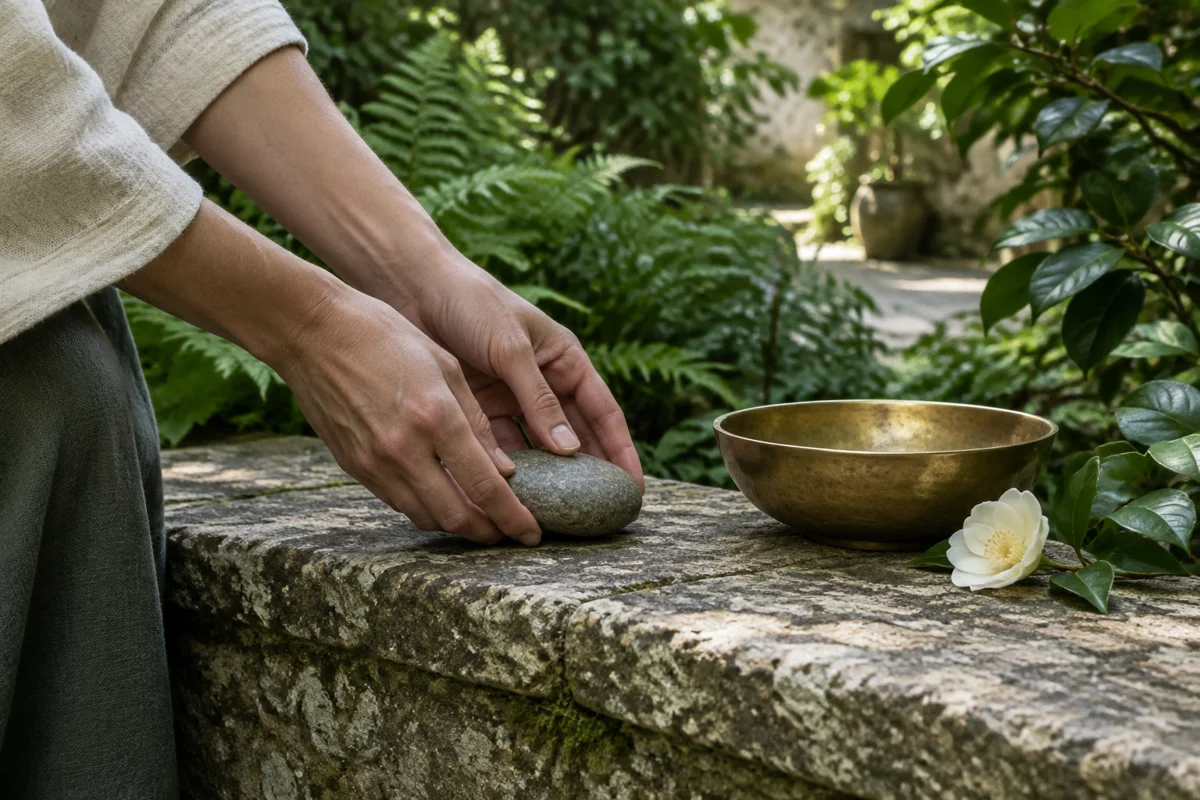
The invisible altar
Most people think of religion as something they believe. Sometimes it is also something they carry.
Alongside the beauty of a tradition can come an invisible altar: obligations, prohibitions, inherited explanations for suffering, and a careful accounting of what makes you worthy of protection. You may never have chosen its contents. You may simply have learned that putting any of them down would make you ungrateful.
Not all traditions function this way. Nor does everyone experience the same tradition in the same way. A practice that steadies one person can frighten another; a symbol that opens a life can become a boundary around it.
The question is not whether the altar is ancient or beautiful. It is whether carrying it leaves you more able to meet the present—or less.
Can you ask an honest question? Can you acknowledge what hurts? Can you change your mind without feeling that your entire existence has become a betrayal?
When a story becomes a script
A myth can illuminate experience. It becomes a script when experience is no longer allowed to disagree with it.
You are angry, but a good devotee is not supposed to be angry. You are exhausted, but sacrifice is supposed to be noble. A relationship is harming you, but the explanation arrives before the examination: a test, a debt, a lesson you must endure.
Gradually, you learn to edit yourself. Not to become kinder or more responsible, but to remain recognisable to the story.
Consider someone invited to an important family ceremony while recovering from illness. They want to rest. Before they can consider their health, a different question takes over: “What will happen to us if I do not attend?” The decision is no longer only about care, family or participation. It has become a negotiation with an imagined consequence.
Your inner life is meant to be a living inquiry, not a museum in which nothing may be moved.
You can honour the people who gave you a story without allowing that story to answer every question your life will ever ask.
Devotion, or the management of fear?
Devotion can be generous. It can nurture humility, courage, discipline and a sense of belonging beyond the self. The problem is not that you love something larger than yourself.
The problem begins when love becomes inseparable from threat.
When a missed ritual feels dangerous. When doubt demands immediate punishment or repair. When every ordinary setback becomes evidence that you have displeased an unseen authority. When you cannot distinguish a freely chosen act from an act performed to prevent catastrophe.
Chosen devotion
- There is room for questions and changing circumstances.
- Practice supports care, responsibility and participation.
- A symbol deepens life without deciding everything for you.
Fear-driven compliance
- Doubt is treated as a threat to your worth or safety.
- Appeasement repeatedly takes priority over actual needs.
- Ordinary events are interpreted as punishment or commands.
These are prompts for reflection, not a diagnosis or a verdict on anyone’s faith. Mixed motives are human. You may find gratitude and fear sitting beside each other in the same prayer.
Simply noticing the difference creates a little room. In that room, choice can begin to return.
Akashic Intelligence is not another throne
It would be easy to put down one authority and install another. Exchange “the deity demands it” for “the Records told me.” Change the vocabulary while preserving the surrender.
That is not the cultivation we are interested in.
At the School of Cultivation, Akashic Intelligence is approached as a spiritual and contemplative practice for examining patterns, refining attention and exercising discernment. Here, its value lies in helping you notice the story beneath a reaction—not in issuing a new set of unquestionable instructions.
If an inner message cannot be questioned, it has become another command—not greater clarity.
Instead of asking, “Which power must I appease?”, ask, “What am I afraid will happen, and where did I learn that fear?” Instead of “What does the field want from me?”, try, “What am I observing, what am I interpreting, and what remains unknown?”
An image, sensation or sentence that arises in contemplation is not proof of a divine demand. It is material to examine. Check it against evidence, your responsibilities, other people’s consent and the consequences of acting on it.
The aim is not to become certain about the invisible. It is to become more honest and capable in the life you can actually meet.
Setting down the weight without burning the bridge
Freedom does not have to begin with a dramatic announcement. Sometimes it begins with a smaller sentence: “I do not know whether I believe this anymore.”
You may keep the music. Keep the festival. Keep the tenderness of a prayer that connects you with someone you love. You may change a practice, leave a community, remain within it, or take time before deciding.
The important distinction is between participating consciously and being unable to imagine permission to choose.
Nor does recovering your authority mean dismissing every teacher or trusting every impulse. Discernment includes being corrected. It includes learning from people who know more than you. It means that no source of guidance is exempt from ethical scrutiny merely because it calls itself sacred.
If questioning brings risks to your safety, housing or family support, proceed carefully. You do not owe anyone a confrontation. Seek trustworthy support and let your circumstances shape the pace.
A five-minute practice in returning to yourself
Choose one manageable inherited expectation—not the most frightening belief in your life. Sit comfortably, notice the room around you, and write a few lines.
- Name the instruction. Complete: “I feel I must…” Be specific. Attend a ceremony, hide a doubt, seek permission before making an ordinary decision.
- Name the feared consequence. Complete: “If I do not, I fear…” Separate a practical consequence, such as family disappointment, from an assumed supernatural one.
- Separate observation from story. What have you actually experienced? What were you told? What do you not know? Leave uncertainty on the page.
- Find the value underneath. Is there something you genuinely want to preserve—gratitude, connection, care, stillness? Could you honour it without the same burden?
- Choose one small, safe response. Ask a question, rest before deciding, adapt a practice, or speak with someone trustworthy. Observe the real outcome rather than treating every coincidence as a sign.
If the exercise increases distress, stop. Orient yourself to your surroundings and seek support if needed. Reflection should not become another ordeal you must complete correctly.
What remains sacred after certainty
For some people, questioning an inherited belief feels like opening a door onto nothing. If the old story no longer explains everything, what will hold the world together?
Perhaps the world does not need to be held together by your obedience.
There is still the morning. Still the person who needs your honest attention. Still the difficult apology, the meal you prepare, the boundary you learn to keep without cruelty. There is still mystery—only now you need not pretend to have settled it.
Putting down a burden does not automatically make you clear, whole or free. It releases energy for the work those words require. You still have to practise attention. Learn responsibility. Notice when fear has found a new costume.
You do not have to make an enemy of the sacred to stop making a sacrifice of yourself.
The question is no longer only, “What must I carry to remain protected?” It becomes, “What can I cultivate so that I meet life with greater clarity, care and courage?”
That is a quieter beginning. And it belongs to you.
This is what the School of Cultivation is for.
A place that helps you grow your own roots — not become dependent on ours. Discernment, depth, and practice that belongs entirely to you.